In short
Workflows are predictable; agents are flexible. Most systems we ship are a workflow on the outside with small, bounded agents inside.
"We want an AI agent" is the most common sentence in our first calls. Often what the team actually needs is a reliable workflow with a language model in one or two steps. Both are useful. They fail in different ways, cost different amounts and need different testing, so it is worth deciding early.
The difference in one sentence
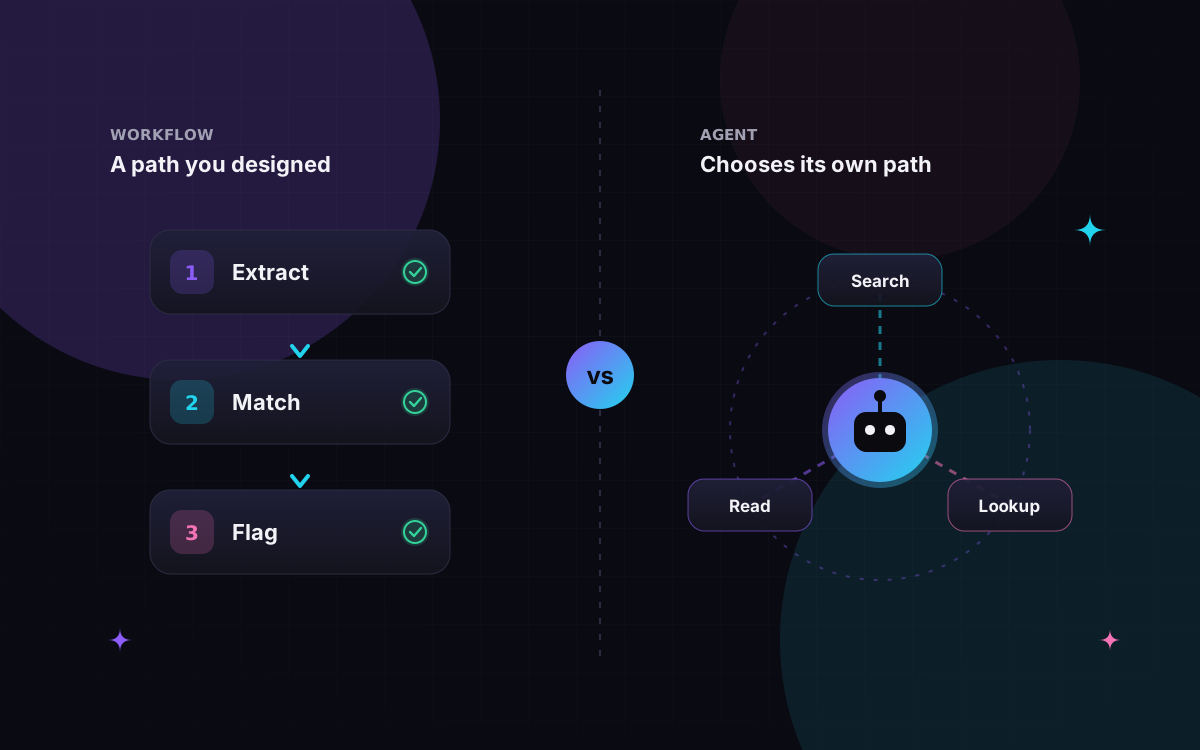
A workflow follows a path you designed: step A, then B, then C, with a model doing some of the steps. An agent chooses its own path: it decides which tool to call next, reads the result and decides again, until it thinks the goal is met.
Workflows are predictable. Agents are flexible. You pay for flexibility with latency, cost and harder testing.
Five questions we ask
- Can you draw the process on a whiteboard? If the steps are known and stable, such as "extract fields from the invoice, match to a purchase order, flag mismatches", build a workflow. Use a model only where the input is messy.
- How many different paths are there? If the honest answer is "it depends on what we find", for example investigating why a shipment is late across three systems, an agent starts to earn its keep.
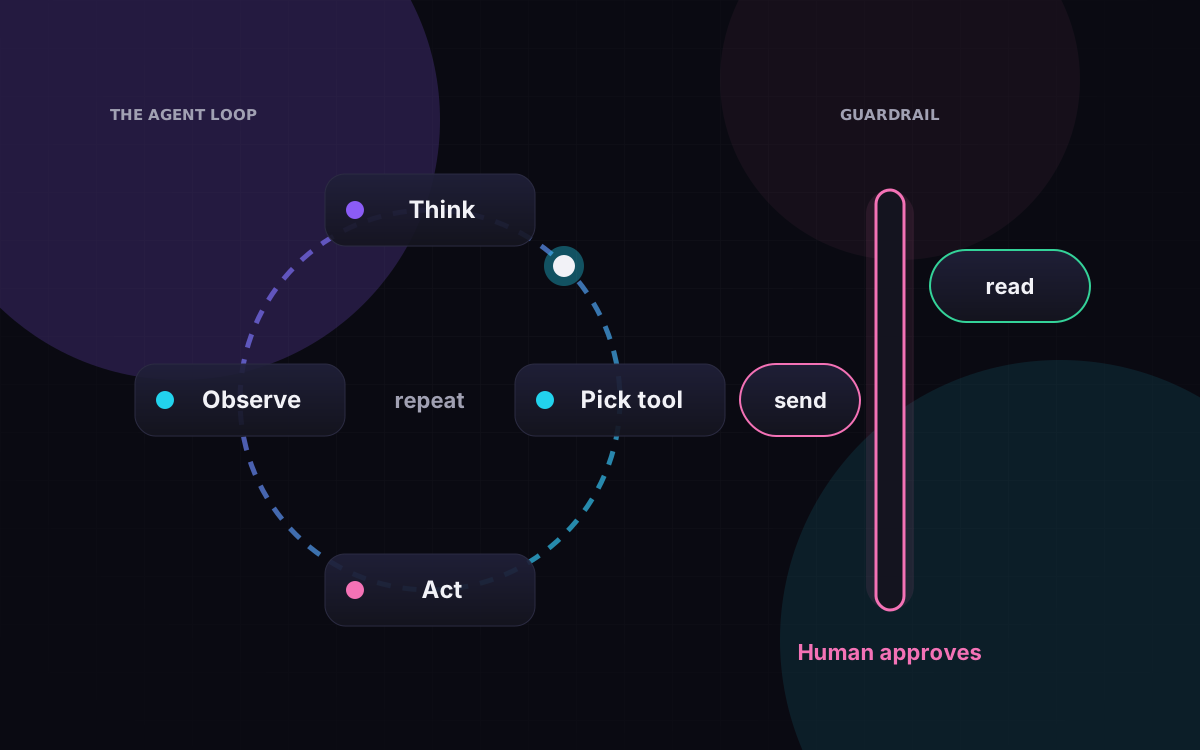
- What does a wrong step cost? An agent that reads data can explore freely. An agent that sends emails, issues refunds or changes records needs approval gates, and at that point part of it is a workflow again.
- How fast must it answer? Every agent loop is another model call. A customer-facing answer in under two seconds usually rules out multi-step reasoning on the hot path.
- Can you test it? For a workflow you test each step. For an agent you need scenario tests that check the final outcome and that it didn't take a dangerous shortcut on the way.
The pattern we use most
In practice most systems we ship are a workflow on the outside with small, bounded agents inside:
- The workflow owns the order of operations, retries, permissions and audit log.
- An agent is given one narrow job, a short list of tools and a budget, for example "find the root cause of this failed delivery using these three read-only lookups, in at most eight steps".
- Anything with side effects, such as writing data, sending messages or spending money, goes through the workflow, which can require a human to approve.
This keeps the parts that must be predictable predictable, and puts the model where judgement actually helps.
Signs you chose wrong
- Your "agent" runs the same five tools in the same order every time. Make it a workflow; it will be faster and cheaper.
- Your workflow has grown dozens of
ifbranches for edge cases a person would handle with common sense. That part may be a good fit for a bounded agent. - You cannot explain why it did what it did. Log every tool call with its inputs and outputs before you go any further.
Where to start
Write down ten real cases, including the awkward ones, before choosing. If you can solve all ten with a fixed sequence, start with the workflow. You can always hand one step to an agent later; taking autonomy away from a system people already rely on is much harder.