In short
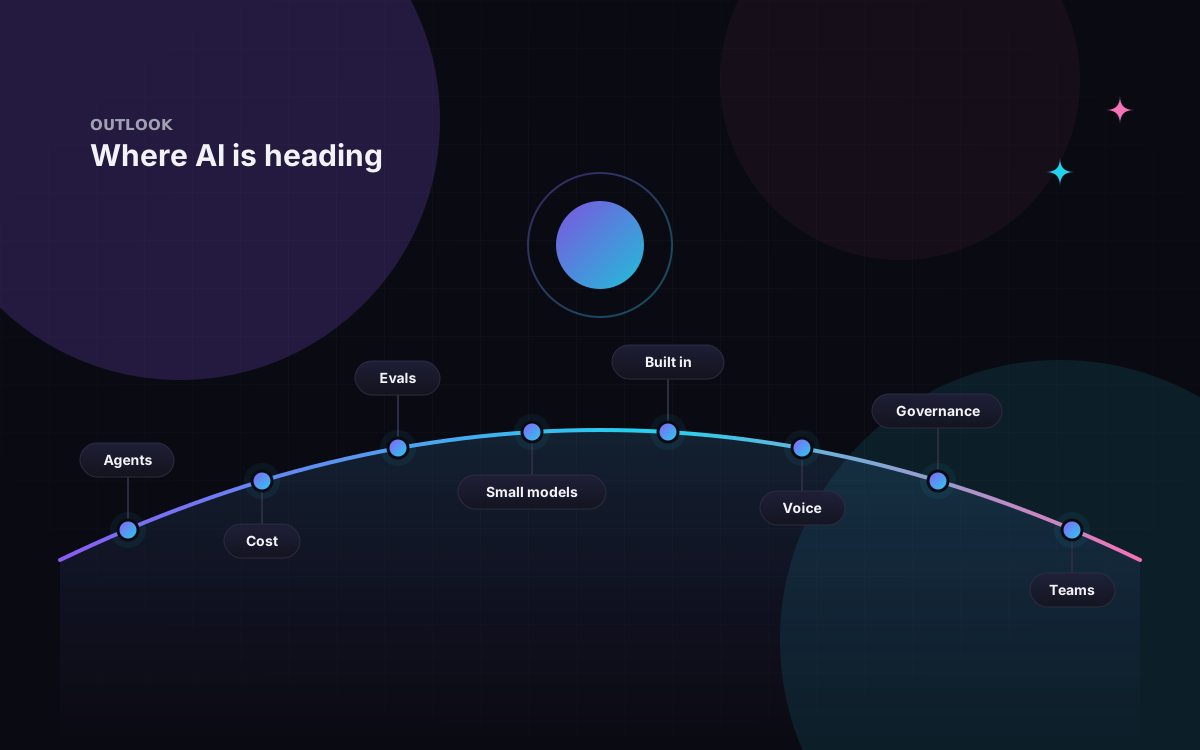
We expect AI to get cheaper, quieter and more accountable rather than more magical. Agents will do real work with people at the checkpoints, evaluation becomes standard, and the businesses that gain most are the ones that start with one well-measured workflow now.
Every week brings a new headline about what AI will do next, and most of it is hard to act on. These AI predictions are narrower: what we expect to change over the next three to five years, based on what we see while building agents, automation, web and mobile apps for businesses. They are opinions, not facts. Some will be wrong. Each one comes with a short note on what it means for your business, so you can decide what to do about it today.
How to read these predictions
We have tried to avoid two traps. The first is hype: assuming every demo becomes a product. The second is dismissal: assuming that because last year's tools were unreliable, next year's will be too. Our bets sit in between and are based on patterns we already see in client projects, just not yet everywhere.
We deliberately avoid dates, model names and market figures. Those age badly. The direction is what matters for planning.
1. Agents move from demos to real multi-step work, with human checkpoints
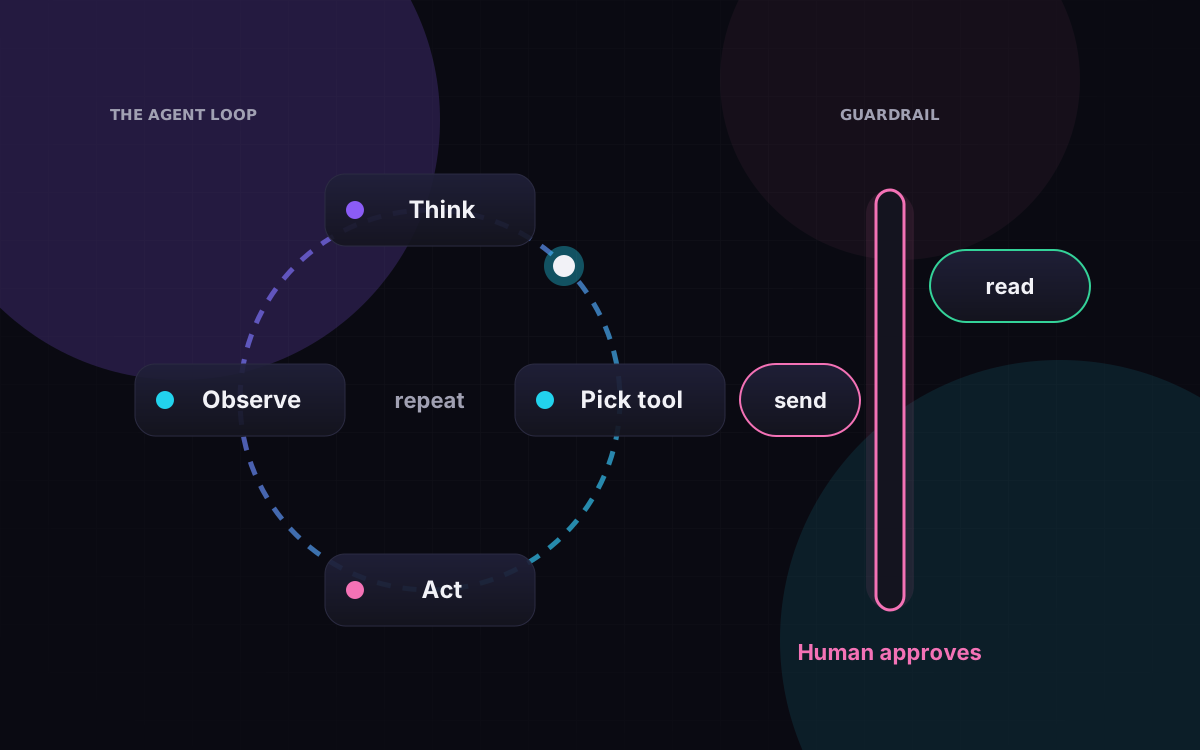
Today many "AI agent" projects stall after the demo. The agent works on the happy path and then does something surprising on case number forty. We expect that to change, not because agents become flawless, but because teams get better at designing around them: narrow jobs, a short list of tools, a step budget, and a person approving anything with side effects.
Our bet is that most useful agents in a few years will look like the pattern we already use: a workflow on the outside, small bounded agents inside. We wrote about that in Agent or workflow?, and our invoice reconciliation agent works the same way. It drafts follow-ups, and a person approves them.
What it means for your business: look for processes where a person currently gathers information from several places before making a decision. Those are good candidates. Keep the decision with the person, and let the agent do the gathering.
2. Cost per task keeps falling, so more workflows become worth automating
The price of getting a given quality of answer from a model has generally moved down over time, and we expect that direction to continue, even if it is uneven and some top-end models stay expensive. The practical effect is that tasks which were not worth automating last year, because each run cost too much for the value it produced, cross the line.
That does not make every automation sensible. A cheap model call inside a badly designed process is still a badly designed process.
What it means for your business: keep a short list of the tasks you rejected for automation on cost grounds. Revisit it every six months or so. Some will have become worth doing without anything else changing.
3. Evaluation and observability become a standard part of every AI project
In ordinary software nobody ships without tests and logs. In AI projects that discipline is still often missing: a prompt gets tweaked, someone tries three examples, and it goes live. We expect this to look as odd in a few years as shipping a web app with no error monitoring looks now.
Concretely, that means a set of real test cases with expected outcomes, run on every change; logs of every model call and tool call; and dashboards for quality, cost and latency, not just uptime.
What it means for your business: when you commission an AI system, ask how its quality will be measured after launch and who looks at the results. If the answer is vague, that is the risk to fix first.
4. Smaller and on-device models handle routine work, frontier models do the hard parts
Not every task needs the most capable model available. Classifying an email, extracting fields from a form or summarising a short note can often be done well by a smaller model that is faster and cheaper, and sometimes runs on the user's own device or your own servers. We expect more systems to route work by difficulty: small models for the routine, larger ones only when the task needs real reasoning.
This also helps with privacy. Data that never leaves the device or your infrastructure is data you do not have to explain to a regulator.
What it means for your business: do not design around a single model. Build so that each step can use a different model, and so that you can swap one out without rewriting the system.
5. AI becomes part of everyday software, not a separate chat window
Right now a lot of AI use means copying text into a chat tool and copying the answer back. We think that phase is temporary. The more lasting form is AI built into the tools people already use: a "draft reply" button in the support inbox, a search box that understands descriptions, a form that fills itself from an uploaded document.
People rarely want a conversation. They want the task done in the place where they already are. We see this in store search and in how our own team works with Claude every day.
What it means for your business: before building a chatbot, ask where in your existing apps the help would be most useful. Often the right feature is a single button, not a new interface.
6. Voice and local languages become normal, including Urdu and regional languages
Many people prefer to speak rather than type, and many prefer their own language to English. Models have become noticeably better at speech and at languages beyond English, though quality still varies a lot between languages, dialects and mixed-language speech. We expect that gap to keep narrowing, which matters a great deal in markets like Pakistan where people switch between Urdu, English and regional languages in a single sentence.
Our crop advisory assistant answers in Urdu and English over WhatsApp. We expect that kind of product to become ordinary rather than special.
What it means for your business: if your customers or staff are more comfortable in a language other than English, test voice and local-language support with real users early. Measure it per language; do not assume English quality carries over.
7. Regulation and data governance shape how systems are built
Rules about AI and data are being written and enforced in many jurisdictions, and they differ from place to place. We will not predict the details. We do expect the general direction to hold: more requirements to explain what a system does, to keep records, to protect personal data and to keep a person responsible for consequential decisions.
Systems built with those habits from the start, as we describe in our healthcare privacy rules, will adapt easily. Systems built without them may need expensive rework.
What it means for your business: know what data your AI systems send, where it goes and how long it is kept. Write it down now. It costs little today and will save a lot later.
8. Work shifts for teams rather than simply disappearing
Our bet is that for most teams AI changes the shape of the work more than the amount of it. Less time goes on first drafts, data gathering and repetitive checks. More time goes on writing clear specifications, reviewing output, handling exceptions and making judgement calls. Those skills become more valuable, not less.
That shift is not automatic. Teams that are given AI tools without new habits often end up reviewing poor output they did not ask for.
What it means for your business: treat AI adoption as a change in how people work, not just a software purchase. Decide who reviews what, and make the review part of the job rather than an afterthought.
What we'd do now
If you want to be ready for the next few years without betting on any single prediction, these steps hold up in almost every scenario:
- Pick one workflow, not ten. Choose a process that is frequent, measurable and currently painful. Start there.
- Write down ten real cases. Include the awkward ones. They become your first test set.
- Measure before and after. Time per task, error rate, cost. Without a baseline you cannot tell whether the system helped.
- Keep a person at the checkpoints. Anything that sends, pays or changes records should need approval until the data shows it can be trusted.
- Stay model-flexible. Avoid designs that depend on one provider or one model.
- Document your data flows. What goes in, what comes out, where it is stored.
- Revisit every six months. Costs, models and rules move. Your shortlist should too.
Planning your next step
We may be wrong about some of these, and we will happily revisit them as things change. The steps above are useful either way. If you would like help choosing the first workflow, designing the checkpoints or building the system, see our services or get in touch. We will start by asking what you want to measure.